Option A
ABS
- Often considered for molded indoor housings
- Texture and secondary finish options depend on grade
- Impact properties vary by grade and temperature
- Check heat and UV exposure before selection

Technical Resource
Engineering properties, mechanical strengths and design considerations for commonly specified thermoplastic resins.
The right plastic depends on load, temperature, chemical exposure, appearance and cost. This guide covers resins buyers commonly compare before a mold is built.
Values here are typical published figures for unfilled general-purpose grades. Fillers, additives and moisture change them a lot, so the final grade is agreed against the resin datasheet and your drawing.

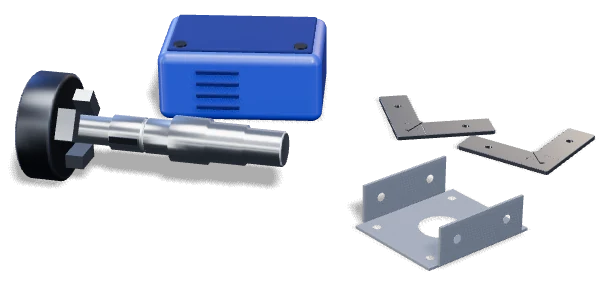
Illustrative photos show shapes and tooling questions to discuss, not completed client work.

| Resin | Density | Tensile | Max service | Shrinkage |
|---|---|---|---|---|
| ABS | 1.05 g/cm3 | 40-50 MPa | 70-85 °C | 0.4-0.7% |
| PC | 1.20 g/cm3 | 60-70 MPa | 115-125 °C | 0.5-0.7% |
| PA66 | 1.14 g/cm3 | 75-85 MPa | 80-120 °C | 1.0-2.0% |
| POM | 1.41 g/cm3 | 60-70 MPa | 85-105 °C | 1.8-2.2% |
| PP | 0.90 g/cm3 | 25-35 MPa | 80-100 °C | 1.0-2.5% |
Compare service conditions first, then review candidate grades against current supplier data and the part drawing.
Compare impact data for candidate ABS and PC grades under the expected temperature, thickness and loading.
Review the continuous-use temperature and heat-deflection data for the selected grade under the actual load.
POM for gears, cams and latches; PA66 for bushings and clips that see higher loads.
Check chemical compatibility for the exact concentration and temperature. Account for moisture-related dimensional change in PA66.
ABS takes texture, paint and plating well. PC and PMMA cover clear parts.
State food contact, flame rating such as UL 94 V-0, or medical use at quotation.
| Resin | Strengths | Watch for | Typical parts |
|---|---|---|---|
| ABS | Tough, easy to mold, plates | Poor UV and heat | Housings, trim |
| PC | Impact, clarity, heat | Stress cracking, scratches | Lenses, guards |
| PC/ABS | Tough, more heat than ABS | Costs more than ABS | Electronic housings |
| PA66 | Strong, wear resistant | Absorbs moisture | Clips, bushings, gears |
| POM | Low friction, stable | Acids; hard to bond | Gears, latches, rollers |
| PP | Chemical resistant, light | Warps; hard to paint | Caps, hinges, tanks |
| PBT | Electrical, chemical | Brittle unfilled | Connectors, sensors |
| PMMA | Clarity, weathering | Brittle | Light guides, covers |
| TPE / TPU | Soft touch, flexible | Bond must be tested | Seals, grips, overmolds |
Common candidates for housings and covers.
Option A
Option B
Compare candidate ABS, PC and PC/ABS grades against impact, heat, appearance, chemical exposure and current pricing.
Typical starting points. Availability and grade are confirmed per project.
Enclosures, covers and containers.
Wear, strength and moving parts.
Lenses, light guides and covers.
Seals, grips and overmolds.
Rules of thumb for early design. Typical values, confirmed per resin and part.
PA66 absorbs moisture from the air after molding. It gets tougher but swells slightly and loses some stiffness. Design fits for the conditioned state, or choose POM where tight dimensions matter in humid service.
Glass fiber, often 30% (GF30), raises stiffness, strength and heat resistance. It also makes shrinkage uneven, so parts can warp, and it wears the mold faster. Gate position and tool steel are chosen with this in mind.
A sample and its application can inform material selection, but visual inspection alone cannot establish an exact resin grade. Supplier data or material testing may be needed before tooling decisions.
It can. Abrasive, filled or corrosive resins need harder or treated tool steel, and shrinkage differs between resins. We discuss this in the design review.
Color matching may be possible with masterbatch or pre-colored resin. Feasibility, tolerance and approval samples are agreed per project.
It can be, depending on the grade and the performance needed. Ask at quotation and we advise on availability and trade-offs.
Send your drawing and intended service conditions for a material and molding-risk review during quotation.

Injection molded housings, covers and technical plastic components, with tooling and production scope reviewed per project.
Learn more
Compare metal finishes by base metal, thickness and callout.
Learn more
A scoped engineering review of design and process considerations.
Learn moreGuidance on quoting, file formats, tooling, quality documentation, delivery and confidentiality.
Learn more